AHTCS Partners with Veterinary Institutes Across Nepal
Kathmandu, Nepal
In Nepal, working equines (horses, mules, and donkeys) remain the backbone of rural transport, agriculture and brick kiln operations. Across the country’s Terai and hilly regions, these animals carry goods, till fields and transport people where roads do not reach. Yet despite their critical economic role, working equines often suffer from preventable conditions: harness wounds, lameness, poor nutrition, and diseases that go untreated due to a shortage of veterinarians confident in equine practice.
Recognizing this gap, Animal Health Training and Consultancy Service (AHTCS), collaborated with Brooke UK — an international animal welfare organization dedicated to improving the lives of working equines is proud to announce significant progress in its Sustainable Equine Welfare Project (SEWP), a flagship initiative aimed at building capacity, improving veterinary education and safeguarding the welfare of working equines across Nepal.
Over the past year alone, the SEWP has directly reached 1,887 working equines across 53 communities in Banke, Bardiya, Bhaktapur and Kavrepalanchowk including 44 Brick Klins, 8 villages and one Tonga stand; treating more than 300 clinical cases ranging from wounds, colic and lameness followed by a few sporadic cases of strangles, glanders and even rabies. The project has trained 46 animal health providers including 13 veterinarians and 27 para-veterinary professionals, shifting instruction from theory-based lectures to hands-on clinical mentoring. However, sustainable change requires reaching veterinarians before they enter practice; at the university level.
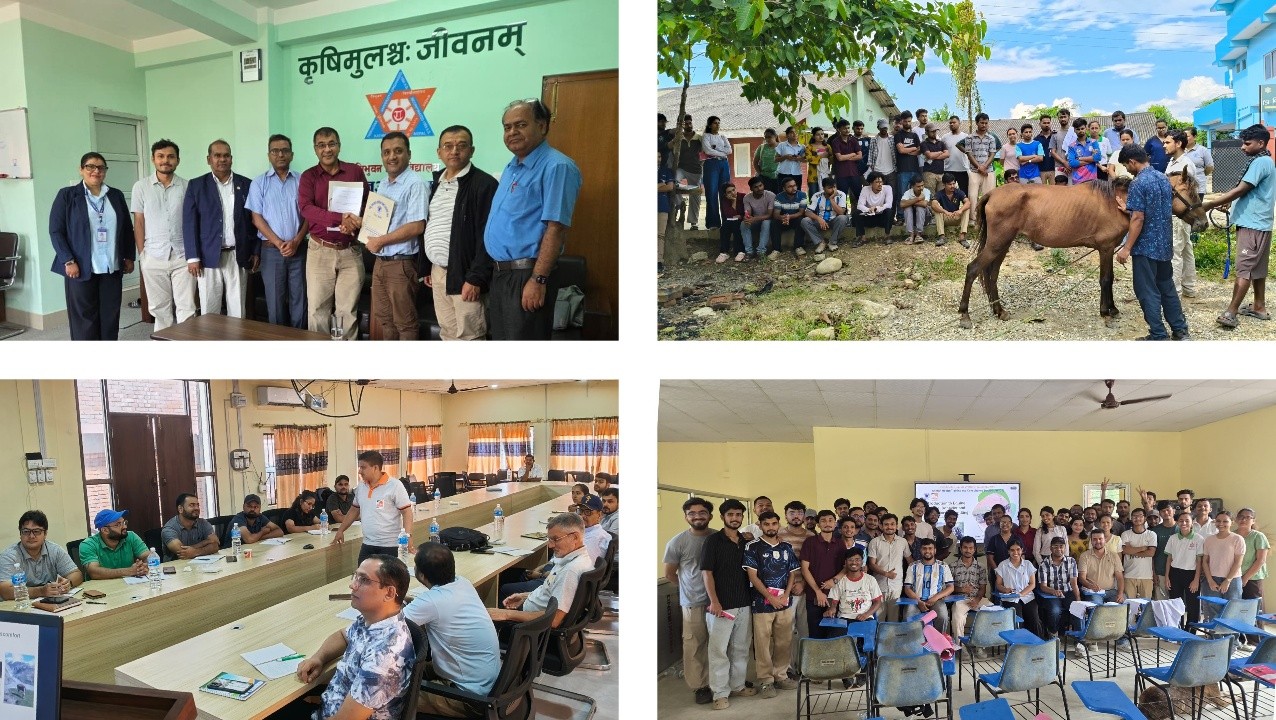
As part of this ongoing effort, AHTCS has formally partnered with four leading Veterinary Training Institutes (VTIs) nationwide, signing Memorandums of Understanding (MoU) with:
- Faculty of Animal, Veterinary and Fisheries Sciences (FAVF), Agriculture and Forestry University (AFU), Rampur Campus
- Institute of Agriculture and Animal Science (IAAS), Tribhuvan University (TU), Paklihawa Campus
- Himalayan College of Agricultural Sciences and Technology (HICAST), Purbanchal University (PU)
- Nepal Polytechnic Institute (NPI), Purbanchal University (PU)
These partnerships mark a critical step toward creating a robust, interconnected network of veterinary professionals equipped to address the health and welfare needs of Nepal’s working equines (horses, donkeys and mules) that remain essential to rural livelihoods, agriculture and transport.
Orientations and Faculty Training: Laying the Groundwork
Over the past several months, AHTCS has successfully conducted student orientation programs at all four partner VTIs; introducing the next generation of veterinarians to the principles of sustainable equine welfare and the vital role of working equines in Nepal’s economy.
In addition, AHTCS organized a faculty training program at FAVF, AFU, Rampur Campus, equipping educators with advanced knowledge and teaching methodologies to integrate equine welfare into their curricula. This investment in faculty development ensures that the impact of the SWEP extends far beyond not only individual workshops but also embedded in the very fabric of veterinary education in Nepal.
“As part of its efforts to strengthen capacity and support to VTIs, AHTCS provided 10 copies of the Working Equid Veterinary Manual to each institute” said Executive Director of AHTCS, Mr. Shiba Kumar Pradhan, “The manuals will serve as valuable reference resources for veterinary undergraduate students with an interest in working equine health, welfare, and management, encouraging further learning and professional development in this field.”
Clinical Skills Labs: A Game-Changer for Veterinary Training
Building on these foundations, AHTCS is now working to establish Clinical Skills Laboratories (CSLs) at each of the four partner VTIs, as well as a dedicated CSL at AHTCS itself.
Clinical Skills Labs are dedicated training spaces where veterinary students can learn, practice and refine essential clinical procedures such as injection techniques, suturing, diagnostic sampling and bandaging, using models and mannequins. As highlighted by The Brooke and supported by academic research (Baillie, Crowther & Dilly, 2015), CSLs provide a safe environment where students can practice repeatedly in a low-stakes environment to develop proficiency without the pressure and risks associated with live animal cases.
This approach addresses a well-documented challenge in veterinary education: while the clinical environment is essential, it can be variable for students. Clinicians must balance teaching with owner needs and animal welfare, and students often experience anxiety about making mistakes that could have serious consequences for live animals. CSLs complement traditional clinical training by allowing students to build confidence and competence in a controlled setting while making them better prepared when they do work with real animals.
While CSLs are common in countries like the UK and Germany, they remain rare in South Asia. By establishing these labs across Nepal, AHTCS is pioneering a landmark contribution to veterinary education in the region: one that benefits both student learning and animal welfare.
What the Labs Will Offer
Each Clinical Skills Lab will be equipped with models and simulators to support training in core procedures. Students will have opportunities for self-directed practice, allowing them to customize their learning and address skill gaps at their own pace. The labs will also serve as ideal venues for practical assessments, such as Objective Structured Clinical Examinations (OSCEs) ensuring that graduates meet the competency standards expected of Day-One veterinarians.
Importantly, AHTCS is committed to ensuring the sustainability of these labs. Drawing on international best practices, the initiative will use locally available materials where possible and foster a culture of knowledge-sharing among partner institutions.
Looking ahead, the SEWP represents AHTCS’s unwavering commitment to sustainable and capacity-driven change. By collaborating with Nepal’s premier veterinary institutions, investing in faculty development, and pioneering the establishment of Clinical Skills Labs, AHTCS is helping to shape a future where every working equine in Nepal has access to knowledgeable and compassionate veterinary care.
Sweta Baral[1]
For more information about the Sustainable Equine Welfare Project (SEWP) and Clinical Skills Labs, please contact AHTCS or visit our website (https://ahtcs.org.np/).